A Marine Giant that Defines Bahía de los Ángeles
Every summer, the waters of Bahía de los Ángeles in the Gulf of California welcome one of the most anticipated visitors of global ecotourism: the whale shark (Rhincodon typus). The largest fish on the planet arrives to feed on plankton in a natural spectacle that draws thousands of tourists and scientists from around the world.
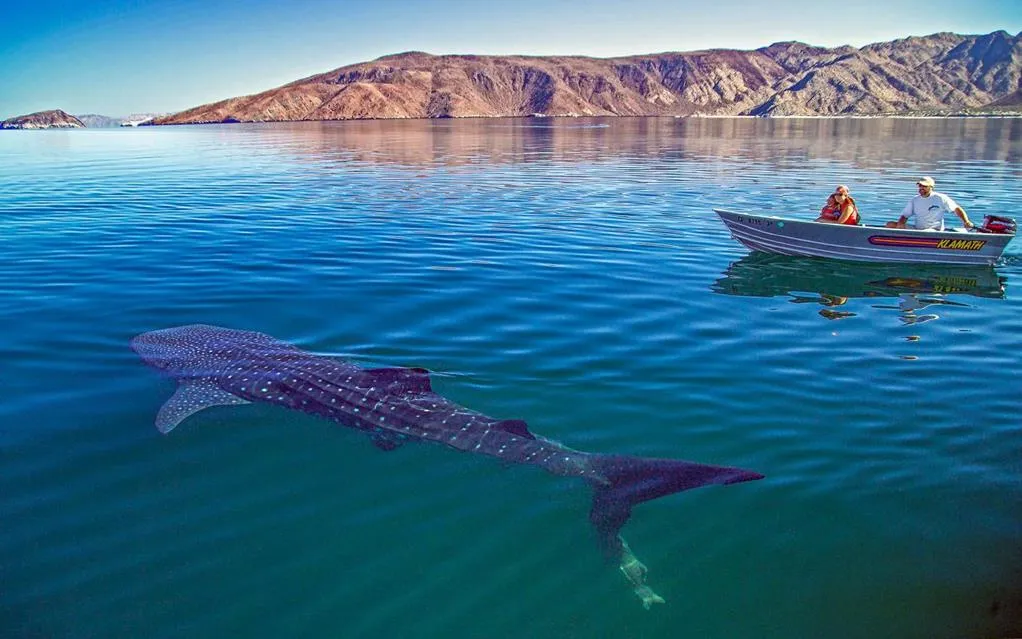

Swimming alongside this gentle giant is not only a breathtaking attraction; it’s also a vital source of income for local communities that have chosen sustainable tourism over reckless exploitation of their resources. But this unique encounter may soon vanish.
The Saguaro Project and the Sierra Madre Pipeline
The Saguaro Energía Project, promoted by Mexico Pacific Limited, plans to install Mexico’s largest liquefied natural gas (LNG) export terminal in Puerto Libertad, Sonora.
The project includes:
- The Sierra Madre Pipeline, stretching more than 800 kilometers through Chihuahua and Sonora.
- A liquefaction plant capable of processing 15 million tons of gas annually.
- The constant passage of massive LNG tankers through the Gulf of California en route to Asia.
Though framed as economic development, the environmental consequences would be devastating—especially for biodiversity hotspots like Bahía de los Ángeles.

A Direct Threat to the Whale Shark
Classified as endangered by the IUCN, whale sharks already face multiple threats that would be magnified by the Saguaro Project:
- Intensive maritime traffic: LNG tankers would exponentially increase the risk of fatal collisions with whale sharks and other migratory species.
- Acoustic pollution: Submarine noise disrupts whale shark feeding and migration.
- Spills and discharges: A single accident could contaminate critical feeding grounds.
- Climate change: The project’s greenhouse gas emissions would worsen ocean warming, reducing plankton—the whale shark’s main food source.

Tourism at Risk: Losing a Local Treasure
In Bahía de los Ángeles, whale shark tourism is more than an attraction—it’s the backbone of the local economy. Boat operators, certified guides, restaurants, and lodging all depend on visitors eager to meet this marine giant.
Without the whale shark, the region would lose:
- A livelihood that sustains hundreds of families.
- An international tourism draw that has put Baja California on the ecotourism map.
- Decades of community-led efforts to build an economy based on conservation.
The hard question remains: how would Bahía de los Ángeles compete without its greatest marine emblem?

An Entire Ecosystem at Risk
The threat goes far beyond whale sharks. Increased tanker traffic would impact:
- Gray and blue whales along their migratory routes.
- Dolphins, manta rays, and sea turtles, all keystone species in the ecosystem.
- Artisanal fisheries, which would suffer from contamination and species displacement.
The Gulf of California, once called the “Aquarium of the World” by Jacques Cousteau, risks being transformed into a fossil fuel shipping corridor.

Social and Environmental Resistance
Local and international organizations are raising their voices against the Saguaro Project. Campaigns like “Whales or Gas?” demand an end to projects that contradict Mexico’s climate commitments and threaten to wipe out sustainable tourism practices that have proven to be viable alternatives for economic growth.
Fishing and tourism communities across Baja California and Sonora warn: the project won’t bring prosperity, only environmental sacrifice zones serving external energy interests.

A Choice Between Whales or Gas
Experts stress the destructive impacts of these projects:
- Tankers up to 300 meters long would invade calving grounds, displacing whales and other marine mammals.
- Collisions, already a leading cause of whale deaths in the Gulf, would become far more frequent.
- Noise pollution could disorient or even deafen cetaceans that rely on acoustic communication for survival.
The domino effect would extend across the ecosystem, threatening dolphins, sea lions, and ultimately the whale shark itself.
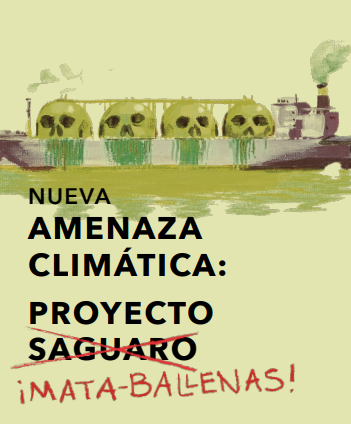
Local Economies in Peril
Thousands of families depend on fishing and marine tourism, especially whale shark and whale watching. Introducing an industrial LNG corridor risks collapsing artisanal fisheries and destroying responsible tourism, as has happened elsewhere.
The project alone would emit 73 million tons of CO₂ annually, comparable to the combined emissions of Portugal and Sweden. Beyond greenhouse gases, nearby communities would face air pollution, health risks, and direct contributions to global warming—what experts call a recipe for climate chaos.

Impact on Local Economies
Thousands of families depend on fishing and marine tourism, especially whale and whale shark watching. The introduction of this industry would put their livelihoods at risk—just as has happened in other places where similar projects led to the collapse of artisanal fishing and the disappearance of responsible tourism.
Pollution and Climate Crisis
The Saguaro Project alone would emit 73 million tons of carbon dioxide equivalent per year—a figure comparable to the combined emissions of countries like Portugal and Sweden.
Added to this are air pollution in areas surrounding the plants, health risks for local communities, and the project’s direct contribution to rising global temperatures. Betting on this kind of infrastructure is, in the words of experts, a bet on climate chaos.
Without Whale Sharks, There Is No Bahía de los Ángeles
The future of Bahía de los Ángeles and its relationship with the whale shark hangs in the balance. If the Saguaro Project moves forward, the bay may lose its most iconic visitor—and with it, much of its identity and economic foundation.
To reject the project is not only to defend a species. It is to defend a way of life, a sustainable tourism model, and the community pride that has made Baja California a global reference for conservation.
The whale shark cannot defend itself. The choice falls to us:
- Do we want a Gulf of California full of life and sustainable tourism?
- Or an industrial gas corridor that steals away its most noble giant forever?
Bahía de los Ángeles knows its answer: every summer, the whale shark must return. The bay’s future depends on the world understanding this truth.
Sign against the project here: Link to sign
Follow us — La Ruta la marcas tú! 🔔
Don’t miss the latest news and updates on sports, entertainment, film, and tourism.